
Identifying cash and cash equivalents is the starting point when preparing the statement of cash flows, as cash flows exclude movements between items that constitute cash or cash equivalents. That’s because these components form part of an entity’s cash management rather than its operating, investing or financing activities (IAS 7.9).
Let’s dive in.
Cash
Cash, as defined in IAS 7.6, comprises cash on hand and demand deposits. However, IAS 7 does not explicitly define either term. Cash on hand is generally understood to mean physical currency, namely notes and coins issued by a central bank. Demand deposits should have liquidity comparable to cash, allowing funds to be withdrawn at any time without a substantial penalty, such as the loss of a significant proportion of accrued interest. A deposit that does not qualify as cash may nevertheless meet the criteria for classification as a cash equivalent.
--Too many IFRS updates? I know the feeling! That's why I created Reporting Period. It's a concise monthly summary of IFRS developments and Big 4 insights for accounting professionals. It's completely free, with zero spam, and you can unsubscribe anytime with one click. Interested? Leave your email below:
Cash equivalents
Cash equivalents are investments that are (IAS 7.6-9):
- held to meet short-term cash commitments rather than for investment or other purposes;
- highly liquid;
- readily convertible to known amounts of cash; and
- subject to an insignificant risk of changes in value.
Generally, an investment should have a maturity of no more than 3 months from the date of acquisition to be regarded as short-term. Although IAS 7 does not impose an absolute 3-month rule, this period is commonly used as a benchmark. The classification determined at initial recognition does not change merely because the investment is approaching maturity.
A deposit with a maturity of more than 3 months may still qualify as a cash equivalent if it can be withdrawn early without a penalty, such as a loss of interest, and is held primarily to meet short-term cash commitments rather than for investment or other purposes.
Example: Investment held for other purposes
A parent company grants its subsidiary a 45-day loan to help it manage a temporary cash shortage. The resulting loan receivable is short-term, is readily convertible to a known amount of cash and carries an insignificant risk of changes in value. However, the parent cannot classify the asset as a cash equivalent because it is not held to meet the parent’s own short-term cash commitments and therefore does not meet the definition of a cash equivalent.
Debt instruments and money market funds
Debt instruments, such as government bonds and high-quality corporate bonds, may meet the criteria for classification as cash equivalents. A key consideration is the risk of default by the issuer, as debt securities carrying significant credit risk cannot be classified as cash equivalents.
Money market funds, also known as liquidity funds, are often used by companies as part of their cash management. They may be treated as cash equivalents if they meet the criteria described above. In particular, units in a fund cannot be classified as cash equivalents merely because they can be converted into cash at any time at the prevailing market price in an active market. The IFRS Interpretations Committee has clarified that the amount receivable must be known at the time of the initial investment and must therefore be subject to an insignificant risk of changes in value.
To mitigate credit risk, entities should select funds that invest exclusively in highly rated debt instruments, have a diversified portfolio and restrict the maturities of their investments to no more than 3 months.
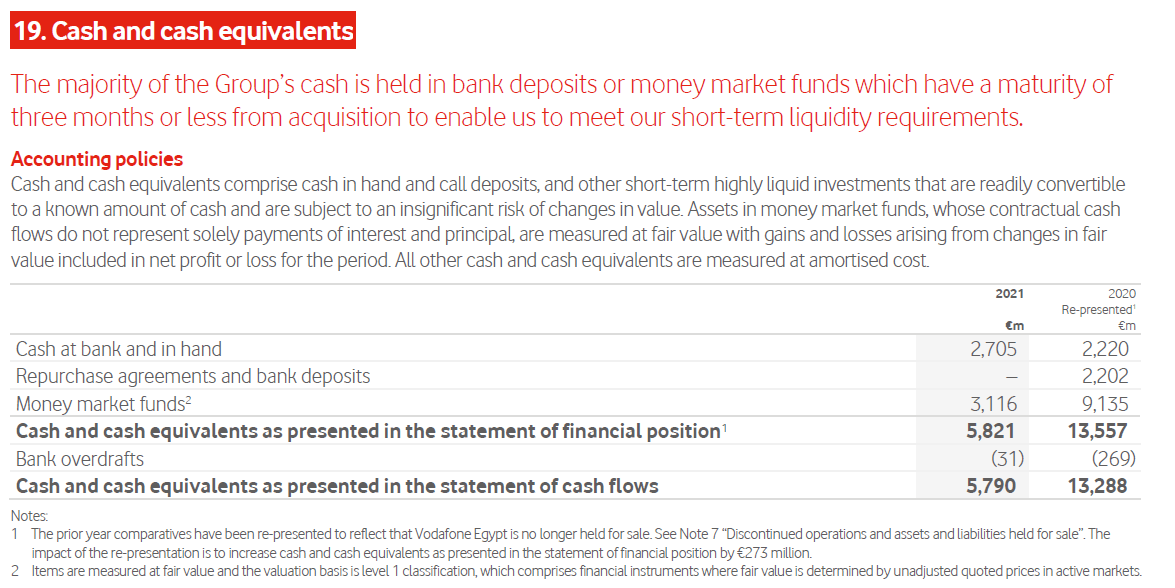
Units in money market funds are usually classified at FVTPL under IFRS 9. However, this does not preclude their classification as cash equivalents in the statement of cash flows. For example, Vodafone discloses that it classifies money market funds as cash equivalents:
Equity instruments
Equity investments are generally excluded from cash equivalents, even when they are highly liquid. There are two main reasons for this:
- the amount of cash into which they can be converted is uncertain at the time of the initial investment, and
- they typically carry a significant risk of changes in value.
However, IAS 7.7 refers to an exception for preference shares acquired shortly before their maturity and with a specified redemption date. Such shares may qualify as cash equivalents if they carry no significant credit risk and are not held for investment purposes.
Intragroup cash pooling arrangements
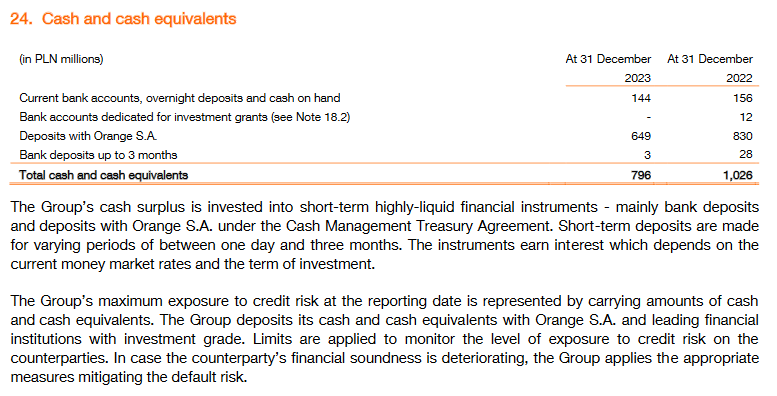
Some groups centrally pool their cash and cash equivalents, which may result in subsidiaries depositing cash with a parent company or another group entity. These balances must be assessed against the criteria in IAS 7, but classification as cash equivalents may be appropriate.
Relevant considerations include the terms and conditions of the intragroup arrangement, the credit rating and liquidity of the group, and its access to external financial resources. For example, Orange’s Polish subsidiary classifies such funds as cash equivalents:
Bank borrowings
Bank borrowings are generally classified as financing activities. However, bank overdrafts may be included as a component of cash and cash equivalents if they are repayable on demand and form an integral part of the entity’s management of cash. A key characteristic of such an arrangement is that the bank balance frequently fluctuates between positive and overdrawn positions (IAS 7.8).
The IFRS Interpretations Committee considered which types of borrowing could be included in cash and cash equivalents. The scenario considered involved an entity using short-term loans and credit facilities with short contractual notice periods, such as 14 days, for the purposes of cash management. However, the balances under the arrangements did not regularly fluctuate between negative and positive positions.
The Committee concluded that the arrangements did not form part of cash and cash equivalents. The absence of a repayment-on-demand feature and the lack of regular fluctuations in the balances were strong indicators that the arrangements were financing rather than cash-management arrangements.
Gold and cryptocurrencies
Gold and cryptocurrencies cannot be classified as cash equivalents because they are not readily convertible into known amounts of cash.
Restricted cash
Restricted cash refers to balances of cash and cash equivalents that are subject to restrictions on their use. IAS 7 gives the example of balances held by a subsidiary that are unavailable for use by the group because of exchange controls or other legal restrictions. Such balances should be disclosed under IAS 7.48-49, as illustrated by this extract from Vodafone’s annual report:

Although not explicitly required, entities commonly disclose other restrictions on cash and cash equivalents, such as restrictions on government grant funds that are earmarked for specified expenditure. Restricted balances should be assessed carefully against the definition of cash and cash equivalents. If they do not meet the relevant criteria, they may need to be classified as other assets.
For example, the IFRS Interpretations Committee considered a scenario in which an entity could freely access a deposit but was contractually required to maintain a specified amount of cash for designated purposes. A failure to maintain that amount would result in a breach of contract. The Committee concluded that the restriction did not affect the classification of the deposit as cash, provided that the entity could access the funds on demand.
Example: Restricted cash
Entity A obtains an investment loan of $100 million from a bank. The proceeds are transferred to a dedicated account that legally belongs to Entity A. However, Entity A must obtain the bank’s approval before withdrawing funds from the account. The approval process is intended to ensure that expenditure is consistent with the agreed budget and timetable.
In this scenario, the $100 million wouldn’t be classified as cash and cash equivalents because Entity A requires a third party’s approval to access the funds. Instead, the most likely accounting outcome is that Entity A would disclose an off-balance sheet credit facility of $100 million.
When funds are actually transferred out of the dedicated account, Entity A would recognise the amounts withdrawn in its statement of financial position as cash and report the inflows as financing activities in the statement of cash flows.
Reconciliation to the statement of financial position
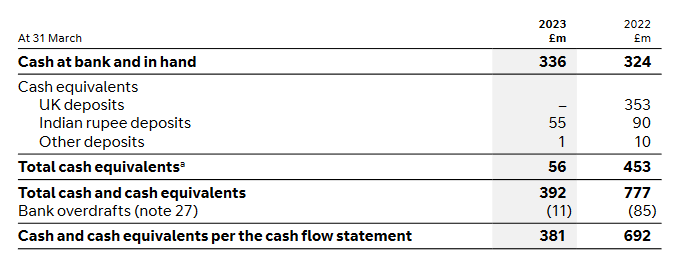
Cash and cash equivalents presented in the statement of cash flows may not correspond to the equivalent line item in the statement of financial position. For example, an entity may present cash and cash equivalents in the statement of cash flows net of on-demand bank overdrafts while presenting the overdrafts as liabilities in the statement of financial position.
A difference may also arise where the cash and cash equivalents of a subsidiary or disposal group are classified as assets held for sale under IFRS 5. When such differences exist, IAS 7.45 requires an entity to reconcile the amounts presented in the two statements. The following extract from BT’s annual report illustrates such a reconciliation:
Disclosure
Entities must disclose their policy for determining the composition of cash and cash equivalents, together with the components making up the overall balance (IAS 7.45-46). If significant judgement is involved in determining whether a particular asset qualifies as a cash equivalent, the entity should provide relevant disclosures under IAS 8.27G (or IAS 1.122 before IFRS 18 is applied).