
Once an entity identifies that it uses management-defined performance measures (MPMs) within the scope of IFRS 18, it must disclose information that enables users of financial statements to understand the aspect of financial performance communicated by each MPM and how the MPM compares with measures defined by IFRS (IFRS 18.121).
Let’s dive in.
MPMs in the primary financial statements
During the development of IFRS 18, the IASB considered prohibiting the presentation of MPMs in the statement of profit or loss on the basis that such presentation could be misleading or give the measures undue prominence. However, IFRS 18 requires entities to present additional line items and subtotals in the primary financial statements when necessary to provide a useful structured summary of income and expenses. The IASB therefore concluded that prohibiting the presentation of MPMs on the face of the statement of profit or loss would contradict this requirement (IFRS 18.BC374-BC375).
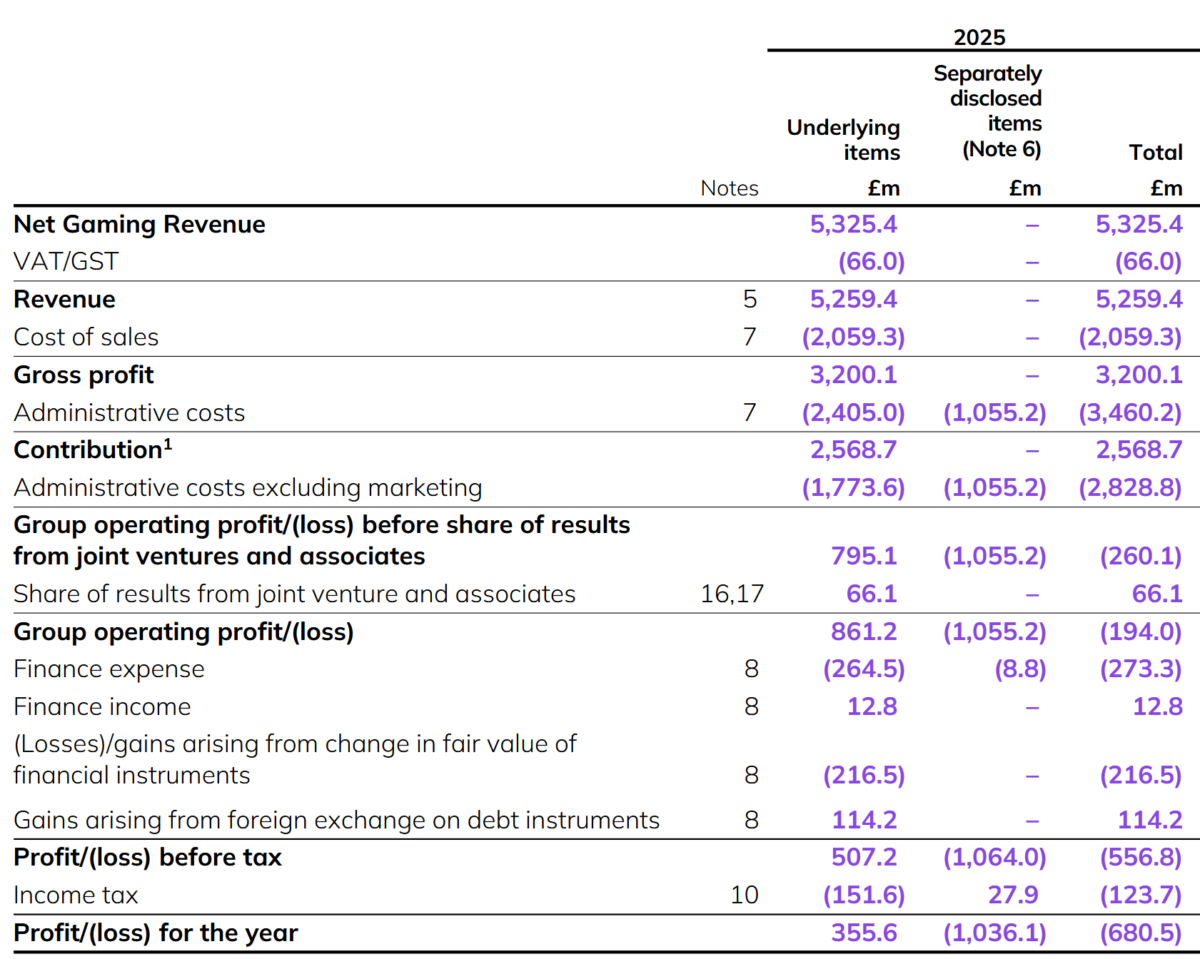
Consequently, an MPM may be presented on the face of the statement of profit or loss as an additional subtotal. Below is an example of ‘Contribution’, defined as gross profit less marketing costs, presented by Entain Group on the face of its statement of profit or loss. The measure is further disaggregated between ‘underlying items’ and ‘separately disclosed items’. Note that the statement of profit or loss is still prepared under IAS 1:
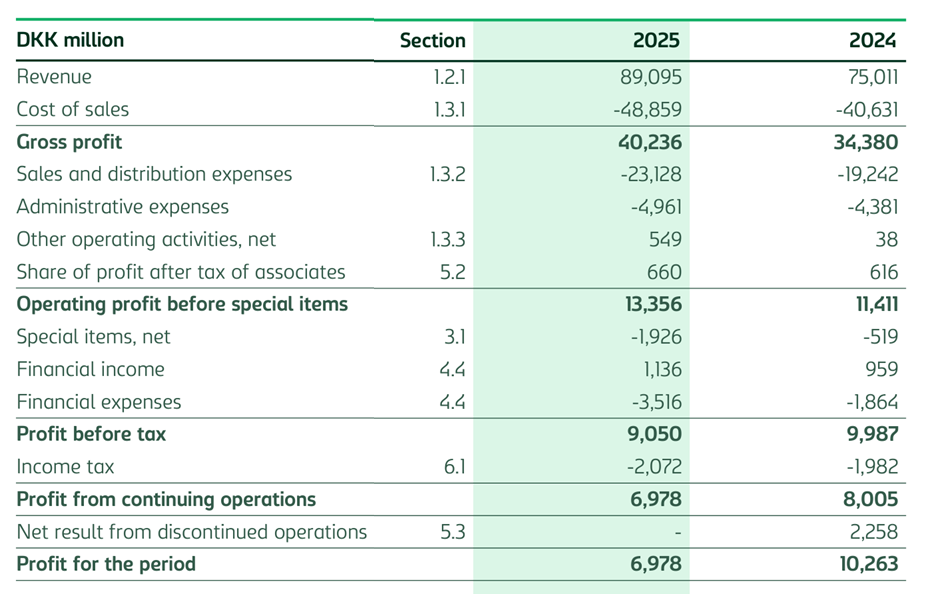
In another example, Carlsberg presents ‘Operating profit before special items’ on the face of its statement of profit or loss. This statement is also still prepared under IAS 1:
Importantly, presenting an MPM on the face of the statement of profit or loss doesn’t relieve the entity of the obligation to comply with all applicable disclosure requirements.
--Too many IFRS updates? I know the feeling! That's why I created Reporting Period. It's a concise monthly summary of IFRS developments and Big 4 insights for accounting professionals. It's completely free, with zero spam, and you can unsubscribe anytime with one click. Interested? Leave your email below:
A single note for MPM disclosures
All disclosures about MPMs must be presented in a single note. If that note also includes other information, the disclosures relating to MPMs must be clearly distinguished.
For example, if information about reportable segments includes an MPM, the required disclosures about that MPM may be included in the same note, provided they are clearly identified as disclosures required by IFRS 18.
The note must also include a statement that the MPMs reflect management’s view of an aspect of the financial performance of the entity as a whole and may not be comparable with measures bearing similar labels or descriptions that are presented by other entities (IFRS 18.122, B132-B133).
Clear and understandable labelling
MPMs must be labelled and described clearly and in a way that isn’t misleading. Investors should be able to understand which items of income and expense are included in, and excluded from, each MPM.
For example, if an entity excludes non-recurring expenses from a subtotal, the label should reflect that adjustment. However, the label of an MPM is not required to explicitly list all the elements excluded from, or included in, the measure. The related disclosures should explain the entity’s policy for excluding particular expenses.
If an entity calculates an MPM using accounting policies that differ from those used in preparing the financial statements, it must disclose that fact and explain how the MPM has been calculated. If the calculation is based on accounting policies that don’t comply with IFRS, the entity must also state that fact and explain the meaning of the terms used (IFRS 18.B134-B135).
Disclosure requirements
The specific disclosures that must be provided for each MPM are set out in IFRS 18.123:
- A description of the aspect of financial performance communicated by the MPM, including an explanation of why the MPM provides useful information about the entity’s financial performance.
- An explanation of how the MPM is calculated.
- A reconciliation between the MPM and the most directly comparable subtotal listed in IFRS 18.118, or a total or subtotal specifically required by IFRS.
- The income tax effect and the effect on NCI for each item disclosed in the reconciliation, together with a description of how the income tax effect was determined.
IFRS 18 doesn’t set out specific comparative information requirements for MPMs. Entities must therefore provide comparative information for all disclosures about MPMs in accordance with the general requirements for comparative information.
Reconciliations
When reconciling an MPM in accordance with IFRS 18.123(c), an entity must disclose the amount relating to each line item in the statement of profit or loss. It must also describe how each reconciling item is calculated and how it contributes to the usefulness of the information provided by the MPM.
Such a description is required when there is more than one reconciling item and the items are calculated using different methods or contribute to the usefulness of the MPM in different ways.
For example, an entity may exclude several expense items from an MPM, with some excluded because they are considered to be outside management’s control and others because they are regarded as non-recurring. In these circumstances, the entity discloses which items relate to each type of adjustment to explain how the MPM provides useful information.
A single explanation may apply to multiple reconciling items or to all reconciling items collectively (IFRS 18.B136-B139).
Income tax effects of reconciling items
In determining the income tax effect of each reconciling item, an entity calculates the effect on the underlying transactions using one of the following approaches:
- The statutory tax rate applicable to the transactions in the tax jurisdiction concerned.
- A reasonable pro rata allocation of the entity’s current and deferred tax in the tax jurisdiction concerned.
- Another method that achieves a more appropriate allocation in the circumstances.
If an entity uses more than one method to determine the income tax effects of its reconciling items, it must disclose how the tax effect has been determined for each item (IFRS 18.B141-B142).
Changes, additions and cessations
If an entity changes how it calculates an MPM, introduces a new MPM, ceases to use a previously disclosed MPM or changes the method used to determine the income tax effects of reconciling items, it must disclose:
- An explanation that enables users of financial statements to understand the change, addition or cessation and its effects.
- The reasons for the change, addition or cessation.
- Restated comparative information reflecting the change, unless it is impracticable to provide that information.
Although the selection of MPMs isn’t an accounting policy choice, an entity applies the impracticability requirements in IAS 8.50-53 when assessing whether comparative information can be restated. If comparative information isn’t restated because doing so is impracticable, the entity must disclose that fact (IFRS 18.124-125).
Examples of disclosure
The illustrative examples accompanying IFRS 18 include Note 2 ‘Management-defined performance measures’, which provides an example of disclosures about MPMs. I’ll add some real-life examples here once companies begin publishing their first financial statements under IFRS 18.
Regulatory guidance
The definition of MPMs in IFRS 18 focuses on only a subset of performance measures, but that isn’t the end of the story. Companies must also comply with the broader expectations of regulators in their jurisdictions regarding alternative performance measures (APMs). These expectations typically include:
- Clear definitions and explanations of the basis of calculation.
- Labels that aren’t misleading.
- Reconciliations to measures defined by IFRS.
- No greater prominence than that given to the corresponding IFRS-defined measure.
For companies based in the European Union, the principal publication is ESMA’s Guidelines on Alternative Performance Measures. The guidelines apply to APMs included in regulated information and prospectuses, but not to measures disclosed within the financial statements themselves.
ESMA defines an APM as a financial measure of historical or future financial performance, financial position or cash flows, other than a measure defined or specified in the applicable financial reporting framework. In 2019, ESMA published a report on the use of APMs and compliance with its guidelines.
Oversight of APMs in the UK has continued to reflect the ESMA Guidelines because they were issued before Brexit. Monitoring is now undertaken by the FCA and the FRC, and the FRC has published its thematic review findings on this topic.
More about IFRS 18
See other pages relating to IFRS 18:
Overview of IFRS 18Statement of Profit or Loss
Categories in the Statement of Profit or Loss
Specified Main Business Activities
Presentation and Disclosure of Operating Expenses
Cost of Sales
Other Comprehensive Income
Statement of Financial Position
Classification of Assets and Liabilities as Current and Non-current
Statement of Changes in Equity
Consistency of Presentation, Disclosure and Classification
Aggregation and Disaggregation in Financial Statements
Offsetting in Financial Statements
Transactions with Owners in Their Capacity as Owners
Identification of Management-Defined Performance Measures
Presentation and Disclosure of Management-Defined Performance Measures
Transition from IAS 1