
IFRS 18 was published by the IASB in April 2024 and is effective for annual reporting periods beginning on or after 1 January 2027. Earlier application is permitted. Once effective, IFRS 18 will replace IAS 1.
IFRS 18 must be applied retrospectively in accordance with IAS 8. However, entities aren’t required to present the quantitative information specified in IAS 8.28(f). Entities applying IFRS 19 aren’t required to comply with IFRS 19.178(f) (IFRS 18.C1-C2).
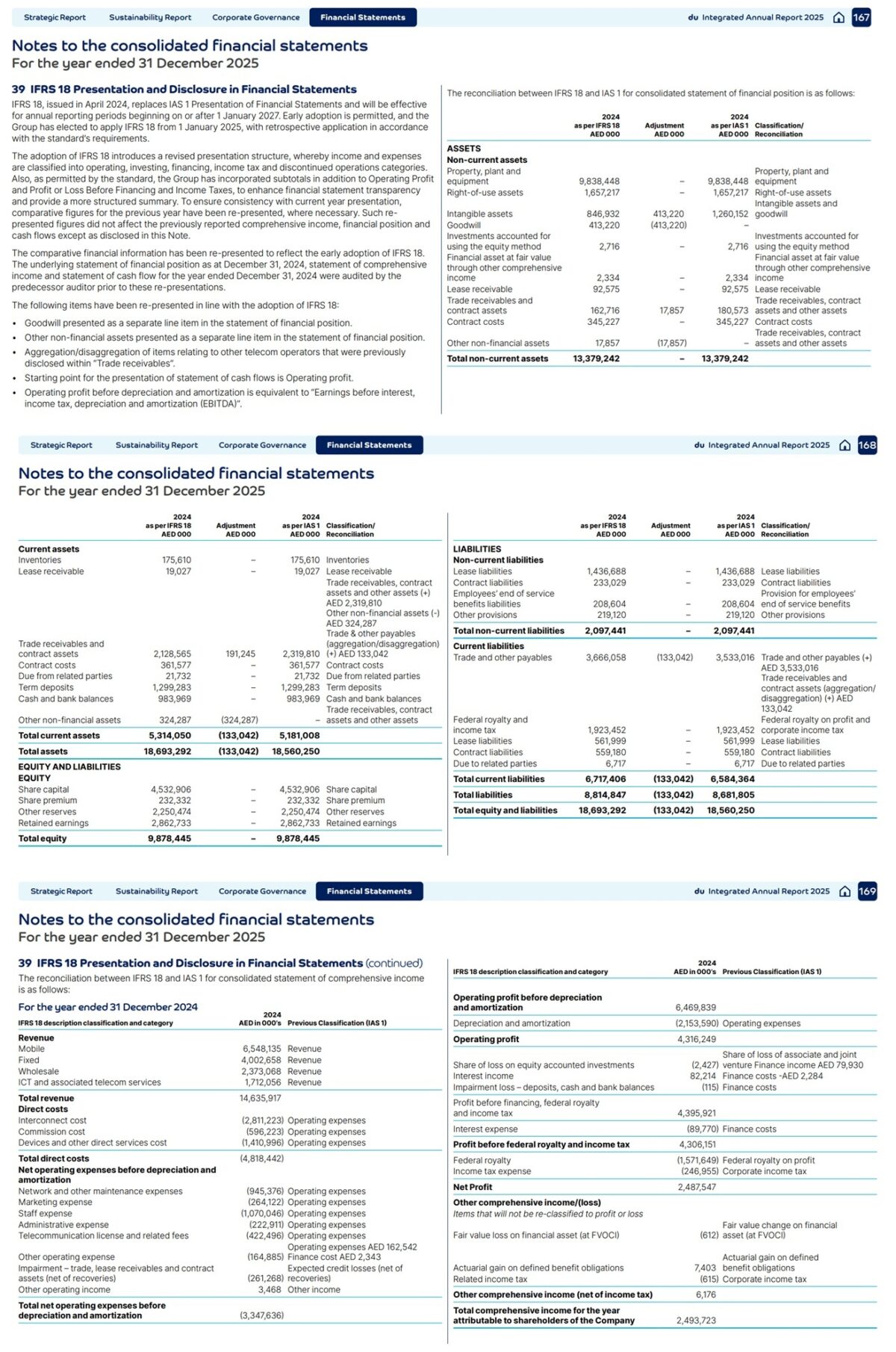
In annual financial statements, an entity must disclose, for the comparative period immediately preceding the first period in which it applies IFRS 18, a reconciliation for each line item in the statement of profit or loss between the amounts restated in accordance with IFRS 18 and those previously presented under IAS 1. An entity may, but isn’t required to, provide these reconciliations for the current reporting period or earlier comparative periods (IFRS 18.C3, C6).
Emirates Integrated Telecommunications Company (aka “du”) bravely adopted IFRS 18 for the 2025 financial year:
Too many IFRS updates? I know the feeling! That's why I created Reporting Period. It's a concise monthly summary of IFRS developments and Big 4 insights for accounting professionals. It's completely free, with zero spam, and you can unsubscribe anytime with one click. Interested? Leave your email below:
Interim financial statements
IAS 34.10 requires an entity to present the same headings and subtotals as those in its most recent annual financial statements. However, in the first year of applying IFRS 18, those annual financial statements will have been prepared under IAS 1 and will therefore include different P/L subtotals.
Accordingly, if an entity prepares condensed interim financial statements under IAS 34 in the first year of applying IFRS 18, it must present each heading it expects to use under IFRS 18, together with the subtotals required by IFRS 18.69-74.
In addition, as part of the disclosures required by IAS 34.16A(a), the entity must disclose reconciliations for each line item presented in the statement of profit or loss for the comparative periods immediately preceding the current and year-to-date periods. The reconciliations are between:
- the restated amounts presented applying the accounting policies for the comparative period and the cumulative comparative period when the entity applies IFRS 18; and
- the amounts previously presented applying the accounting policies for the comparative period and cumulative comparative period when the entity applied IAS 1.
An entity may, but isn’t required to, disclose these reconciliations for the current period or earlier comparative periods (IFRS 18.C4-C6).
An entity applying IFRS 19 instead discloses a reconciliation as part of the information required by IFRS 19.246(a) (IFRS 18.C5).
Amendments to other IFRS
Once effective, IFRS 18 will also amend other IFRS:
IAS 7
- Operating profit or loss will become the mandatory starting point for companies presenting operating cash flows under the indirect method (IAS 7[2027].18(b)).
- The optionality in the classification of cash flows from interest and dividends will be removed (IAS 7[2027].34A-34D).
IAS 8
In finalising IFRS 18, the IASB concluded that certain requirements relating to the general features of financial statements, together with some disclosure requirements in IAS 1, would be more appropriately aligned with the objectives of IAS 8. Accordingly, the IASB decided to relocate the following requirements to IAS 8:
- The concepts of fair presentation and compliance with IFRS.
- Going concern disclosures.
- Accounting policy disclosures.
- Disclosures about judgements and sources of estimation uncertainty.
As a result, IAS 8 will be retitled Basis of Preparation of Financial Statements.
IAS 33
The types of additional EPS measures that companies are permitted to disclose will be restricted to those for which the numerator is the amount attributable to ordinary equity holders of the parent entity and is either (IAS 33(2027).73B-73C):
- A total or subtotal identified in paragraphs 69, 86 and 118 of IFRS 18; or
- A management-defined performance measure (MPM).
IAS 34
Companies will be required to provide the MPM disclosures set out in IFRS 18.121-125 in condensed interim financial statements (IAS 34[2027].16A(m)). However, companies won’t need to repeat other information about MPMs disclosed in their recent annual financial statements (IAS 34[2027].BC10B).
More about IFRS 18
See other pages relating to IFRS 18:
Overview of IFRS 18Statement of Profit or Loss
Categories in the Statement of Profit or Loss
Specified Main Business Activities
Presentation and Disclosure of Operating Expenses
Cost of Sales
Other Comprehensive Income
Statement of Financial Position
Classification of Assets and Liabilities as Current and Non-current
Statement of Changes in Equity
Consistency of Presentation, Disclosure and Classification
Aggregation and Disaggregation in Financial Statements
Offsetting in Financial Statements
Transactions with Owners in Their Capacity as Owners
Identification of Management-Defined Performance Measures
Presentation and Disclosure of Management-Defined Performance Measures
Transition from IAS 1