
IFRS 18 requires income and expenses included in the statement of profit or loss to be classified into one of five categories (IFRS 18.47):
- operating,
- investing,
- financing,
- income taxes, and
- discontinued operations.
However, this doesn’t mean that each P/L line item must be explicitly labelled as belonging to one of these categories. Instead, the classification facilitates the presentation of the required subtotals.
Let’s dive in.
Classification criteria
The diagram below summarises the classification criteria applied by most entities:
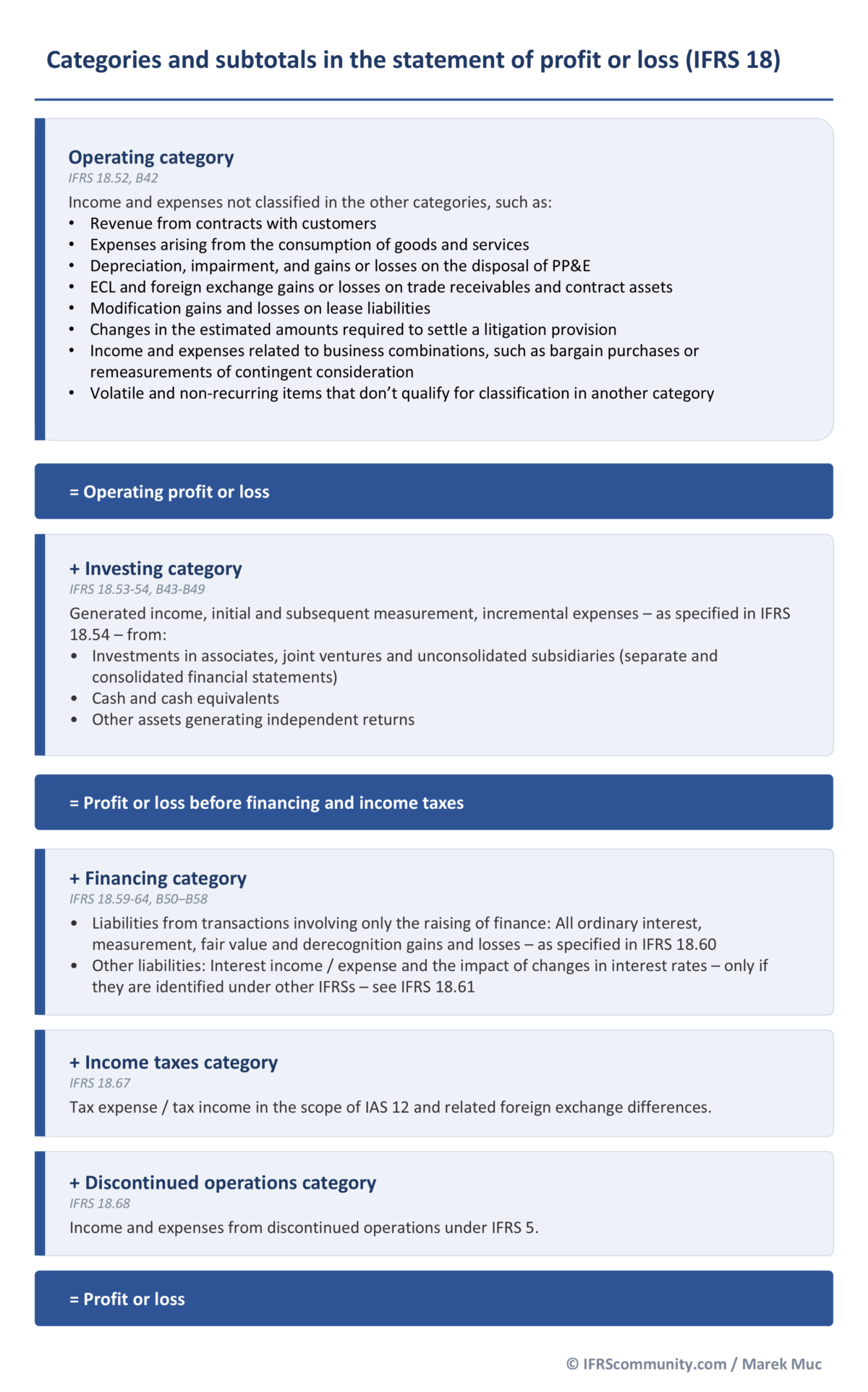
However, specific requirements apply to entities with, as IFRS 18 puts it, specified main business activities (SMBA).
--Too many IFRS updates? I know the feeling! That's why I created Reporting Period. It's a concise monthly summary of IFRS developments and Big 4 insights for accounting professionals. It's completely free, with zero spam, and you can unsubscribe anytime with one click. Interested? Leave your email below:
Operating category
The operating category functions as the residual category: income and expenses are classified as operating unless they meet the criteria for classification in another category. As a result, the operating category is broader than income and expenses arising from an entity’s main business activities as it may also include volatile or non-recurring items that do not qualify for classification in another category (IFRS 18.52, B42).
Investing category
Scope of the investing category
The investing category comprises income and expenses arising from the following assets (IFRS 18.53):
- investments in associates, joint ventures and unconsolidated subsidiaries, including all subsidiaries in the separate financial statements of the parent (see IFRS 18.B43-B44);
- cash and cash equivalents; and
- other assets that generate a return individually and largely independently of the entity’s other resources.
For those assets, the income and expenses classified in the investing category include the following (IFRS 18.54, B47):
- income generated by the assets, such as interest, rental income or dividends;
- income and expenses arising from the initial and subsequent measurement of the assets, such as depreciation, impairment losses and fair value remeasurements;
- gains and losses on derecognition of the assets, or on their classification and remeasurement as held for sale; and
- incremental expenses directly attributable to the acquisition or disposal of the assets, such as transaction costs and costs to sell.
Assets generating independent returns
Assets that generate returns individually and largely independently of an entity’s other resources typically include investments in financial assets and investment property. An asset can generate a return ‘individually and largely independently’ of an entity’s other resources even when there is some interaction between the asset and the entity’s other resources. Income and expenses arising from such assets, as specified in IFRS 18.54, are classified in the investing category.
By contrast, assets used in combination to produce or supply goods or services don’t generate returns individually and largely independently of the entity’s other resources. These assets typically include PP&E, intangible assets, inventories and receivables arising from the production or supply of goods and services. Income and expenses arising from such assets are classified in the operating category. They typically include revenue, depreciation and impairment losses, as well as gains and losses on derecognition (IFRS 18.B45-B49).
Financing category
Two types of liabilities
IFRS 18 requires an entity to distinguish between two types of liabilities when determining which income and expenses are classified in the financing category:
- liabilities arising from transactions that involve only the raising of finance, and
- other liabilities.
This distinction is important because the scope of the income and expenses classified in the financing category differs for each type of liability (IFRS 18.59).
Liabilities arising from transactions involving only the raising of finance
For liabilities arising from transactions that involve only the raising of finance, the financing category includes (IFRS 18.60):
- income and expenses recognised in P/L from the initial and subsequent measurement of those liabilities, including on derecognition; and
- incremental expenses directly attributable to issuing or extinguishing the liabilities, such as transaction costs.
A transaction involves only the raising of finance when an entity receives finance in the form of cash or another financial instrument and will subsequently repay cash or deliver its own equity instruments (IFRS 18.B50).
This category includes typical debt instruments, such as bonds and loans. It also captures certain liabilities arising under supplier finance arrangements. For example, it applies when a payable for goods or services is derecognised because the entity has been discharged from the original financial liability for those goods or services and is instead obliged to settle the supplier financing liability by paying cash (IFRS 18.B51).
For liabilities arising from transactions that involve only the raising of finance, all related income and expenses are classified in the financing category. This includes interest expense, fair value gains and losses, and gains or losses on derecognition (IFRS 18.B52).
Other liabilities
Other liabilities are liabilities that do not arise from transactions involving only the raising of finance. In these cases, the entity has received something other than finance, such as goods, services, a right-of-use asset or employee services. Examples include (IFRS 18.B53):
- payables for goods or services that will be settled in cash, where the entity has received goods or services rather than finance;
- contract liabilities, where the entity will transfer goods or services rather than return cash;
- lease liabilities, where the entity has received a right-of-use asset rather than finance in the form of cash or another financial instrument;
- defined benefit pension liabilities, where the entity has received employee services; and
- decommissioning or litigation provisions.
For these ‘other’ liabilities, the financing category is narrower. It includes:
- interest income and expenses, and
- income and expenses arising from changes in interest rates,
– but only when the entity identifies those amounts for the purpose of applying other IFRSs (IFRS 18.61).
Examples include (IFRS 18.B54):
- interest expense on payables arising from the purchase of goods or services, as required by IFRS 9;
- interest expense on a contract liability with a significant financing component, as required by IFRS 15;
- interest expense on a lease liability under IFRS 16;
- net interest expense or income on a net defined benefit liability or asset, as required by IAS 19; and
- the increase in the discounted amount of a provision arising from the passage of time, together with the effect of any change in the discount rate on provisions, applying IAS 37.
By contrast, income and expenses arising from the underlying transaction or event that gave rise to the liability are not classified in the financing category – they are classified in the operating category (IFRS 18.B55).
Income taxes category
The income taxes category comprises current and deferred tax expense within the scope of IAS 12 only, including related foreign exchange differences (IFRS 18.67).
Presentation of substitutes for income tax
The IASB is considering amending IFRS 18 to allow certain tax charges that are outside the scope of IAS 12 to be classified in the income taxes category under IFRS 18 when they are imposed as a direct substitute for income tax. Examples of taxes likely to be affected include:
- Saudi Arabian zakat, where zakat and income tax apply to different ownership interests;
- tonnage taxes in the UK (and possibly other jurisdictions), where eligible shipping companies may be taxed by reference to fleet tonnage instead of taxable profits; and
- certain hybrid tax regimes where a company pays taxes on taxable profits but is still subject to a minimum amount of tax calculated using a measure other than profit.
Discontinued operations category
The discontinued operations category comprises income and expenses from discontinued operations as defined in IFRS 5 (IFRS 18.68).
Foreign exchange differences
Foreign exchange gains and losses are classified in the same category as the income and expenses from the items that gave rise to those differences. For example, foreign exchange differences on trade receivables are classified in the operating category, while those arising on debt are classified in the financing category.
Consistent with the classification criteria for the financing category, all foreign exchange differences arising on liabilities from a transaction that does not involve only the raising of finance (i.e., ‘other liabilities’) must be classified in the operating or investing category (IFRS 18.B65-B67).
However, if applying these requirements would involve ‘undue cost or effort’, the entity classifies the affected foreign exchange differences in the operating category (IFRS 18.B68).
Gains and losses on derecognition
Derecognition of assets
Income and expenses from the derecognition of assets are classified in the same category as the income and expenses from that asset immediately before derecognition. This also applies to income and expenses arising on classification as held for sale and any subsequent measurement while held for sale (IFRS 18.B60). For example, an entity classifies gains and losses on the disposal of PP&E in the operating category, while a gain or loss on the disposal of investment property is classified in the investing category, unless the entity invests in investment property as a main business activity.
Derecognition of liabilities
Income and expenses from the derecognition of liabilities are classified by applying the general requirements in IFRS 18.59-60 (IFRS 18.B61). For example, an entity that does not provide financing to customers as a main business activity classifies income and expenses from the derecognition of a liability arising from a transaction involving only the raising of finance in the financing category.
Changes in use of an asset
When a change in the use of an asset results in a change in the P/L category in which the related income and expenses are classified, any reclassification gains or losses are included in the category applicable immediately before the reclassification. For example, an entity classifies in the operating category any income or expenses arising on the transfer of property from the scope of IAS 16 to investment property within the scope of IAS 40 (IFRS 18.B62).
Groups of assets and liabilities
An entity may derecognise or reclassify as held for sale a group of assets and liabilities that generated income and expenses in different categories. In such cases, income or expenses arising on the derecognition or reclassification are recognised in the operating category. However, if all assets in the group, other than income tax assets, generated income and expenses classified in the investing category immediately before the event, the income or expenses arising on derecognition or reclassification are classified in the investing category.
For example, an entity classifies gains and losses on the disposal of a consolidated subsidiary in the operating category if the subsidiary included assets that generated income and expenses classified in the operating category immediately before disposal. Likewise, an impairment loss recognised on the classification of a disposal group as held for sale is classified in the operating category unless that group consisted solely of assets that generated income and expenses in the investing category (IFRS 18.B63-B64).
Derivatives and hedging instruments
Gains and losses on a financial instrument designated as a hedging instrument are classified in the same category as the income and expenses affected by the risks that the financial instrument is used to manage. Gains and losses on an undesignated component of a designated hedging instrument are classified in the same category as gains and losses on the designated component. Ineffective portions are classified in the same category as the effective portions.
These requirements also apply to gains and losses on derivatives that are not designated as hedging instruments but are used to manage identified risks. Such gains and losses are classified in the financing category only if the derivative relates to a transaction that involves only the raising of finance, and in the operating category otherwise.
However, if applying these requirements would require the grossing up of gains and losses on hedging instruments or derivatives not designated as hedging instruments, an entity classifies all such gains and losses in the operating category (IFRS 18.B70-B76).
These requirements are summarised in Figure 5 Classification of gains and losses on derivatives within Illustrative Examples to IFRS 18.
More about IFRS 18
See other pages relating to IFRS 18:
Overview of IFRS 18Statement of Profit or Loss
Categories in the Statement of Profit or Loss
Specified Main Business Activities
Presentation and Disclosure of Operating Expenses
Cost of Sales
Other Comprehensive Income
Statement of Financial Position
Classification of Assets and Liabilities as Current and Non-current
Statement of Changes in Equity
Consistency of Presentation, Disclosure and Classification
Aggregation and Disaggregation in Financial Statements
Offsetting in Financial Statements
Transactions with Owners in Their Capacity as Owners
Identification of Management-Defined Performance Measures
Presentation and Disclosure of Management-Defined Performance Measures
Transition from IAS 1