
Other comprehensive income (OCI) is, alongside the statement of profit or loss, part of financial performance reporting under IFRS. In fact, there’s no conceptual basis for differentiating between income and expenses included in P/L and those presented in OCI because, conceptually, they’re all equally important items of income and expense.
Let’s dive in.
Presentation alternatives
The statement of financial performance, which is a primary financial statement, can be presented in one of two permitted formats (IFRS 18.12):
- Two separate statements: a statement of profit or loss (P/L) and a statement presenting comprehensive income that begins with profit or loss for the period. This is the most common approach; or
- A single statement of P/L and OCI, with P/L and OCI presented in two sections. If an entity chooses this option, which is much less common, it must present the P/L section first, followed directly by the OCI section.
IFRS 18 uses the term ‘statement presenting comprehensive income’ to refer both to the OCI section of a single performance statement and to a separate statement presenting comprehensive income (IFRS 18.13). For simplicity, I’m often referring to both as ‘OCI’.
--Too many IFRS updates? I know the feeling! That's why I created Reporting Period. It's a concise monthly summary of IFRS developments and Big 4 insights for accounting professionals. It's completely free, with zero spam, and you can unsubscribe anytime with one click. Interested? Leave your email below:
Totals and subtotals
The statement presenting comprehensive income must include the following totals:
- profit or loss;
- other comprehensive income; and
- total comprehensive income, being the total of profit or loss and other comprehensive income.
In addition, a parent preparing consolidated financial statements must present an allocation of comprehensive income for the reporting period between non-controlling interests and owners of the parent (IFRS 18.86-87).
OCI items must also be split into two categories (IFRS 18.88):
- items that will be reclassified to profit or loss when specific conditions are met; and
- items that will not be reclassified to profit or loss.
Finally, within each category, the entity presents line items for (IFRS 18.89):
- the share of OCI of associates and joint ventures accounted for using the equity method; and
- other items of OCI.
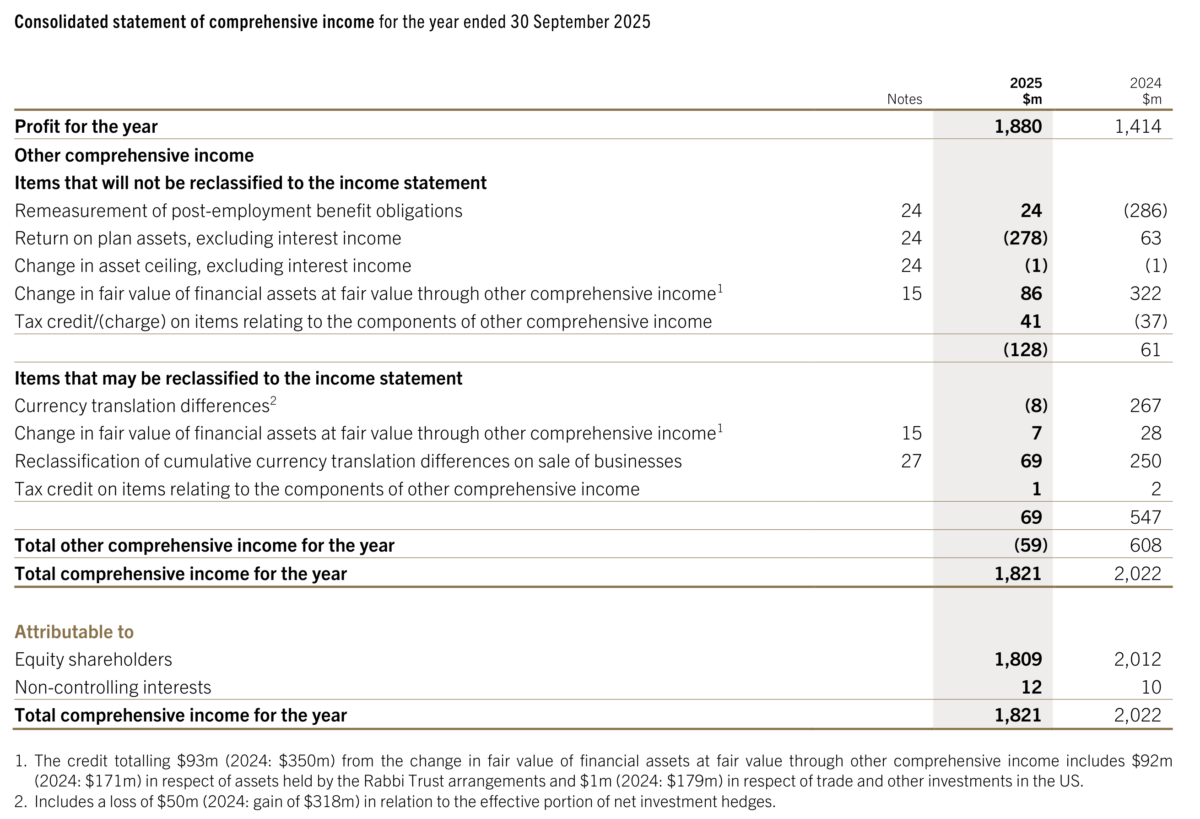
Below is an example of a separate statement presenting comprehensive income presented by Compass Group, still under IAS 1:
Conceptual basis
OCI was introduced into IFRS through the overhaul of IAS 1 that became effective in 2009. Before that, some items of income and expense, such as revaluation of PP&E, were simply recognised directly in equity. However, the IASB wanted to move towards an approach under which only the effects of transactions with owners would be recognised directly in equity, while other changes in assets and liabilities would be reported as income or expense for the period.
However, the broader financial community wasn’t ready to bring all of the income and expenses it was used to seeing directly in equity straight into P/L. Faced with the likely resistance, the IASB introduced the concept of other comprehensive income. To this day, there’s no clear conceptual basis for distinguishing between what affects P/L and what is presented in OCI. The BC paragraphs to IAS 1 acknowledged that there was no conceptual basis for this distinction, but they weren’t carried forward to IFRS 18. So, apparently, the IASB has given up looking for such a basis entirely.
Components of OCI
The overarching rule set out in IFRS 18.46 is that all income and expenses are recognised in P/L unless they’re specifically allowed or required to be presented in OCI. Income and expenses may also be required to be recognised directly in equity if they arise from the correction of errors or changes in accounting policies (IFRS 18.B86).
IFRS 18.B87 includes a complete list of items recognised in OCI. These include, for example, revaluation of PP&E, remeasurements of defined benefit plans under IAS 19 and effects of translating foreign operations.
Reclassification adjustments
Some OCI items are subsequently reclassified to P/L. Such reclassifications are referred to as ‘reclassification adjustments’ or, more casually, as ‘recycling’. However, this doesn’t apply to all OCI items and is permitted only when required by a specific IFRS standard. For example, a reclassification adjustment arises when an entity disposes of a foreign operation for which translation adjustments were recognised in OCI and accumulated as a cumulative translation adjustment (CTA).
A reclassification adjustment is included within the related component of OCI in the period in which the amount is reclassified to P/L. This avoids double counting in total comprehensive income. For example, the accumulation of a positive CTA is recognised as:
- DR Net assets (SoFP): $1,000
- CR Translation adjustment (OCI): $1,000
Then, on disposal of the foreign operation, the CTA is reclassified to P/L as follows:
- DR Translation adjustment (OCI): $1,000
- CR Gain on disposal of foreign operation (P/L): $1,000
As I mentioned earlier, some OCI items are never reclassified to P/L. For example, a revaluation surplus recognised under IAS 16 or IAS 38 is never reclassified to P/L, even on disposal of the related asset. Similarly, reclassification adjustments don’t arise when cash flow hedge accounting results in the recognition of a ‘basis adjustment’. In such cases, the amounts are transferred directly to the carrying amount of the related asset or liability (IFRS 18.B88-B89).
IFRS 18.92 requires reclassification adjustments to be presented in the primary financial statement either separately or together with the items recognised for the period – that is, on a net basis. If they aren’t presented separately, they must be disclosed in the notes.
Note 3—Analysis of reclassification adjustments within Illustrative Examples to IFRS 18 shows what such a disclosure could look like.
Income tax effects
OCI items can be presented either (IFRS 18.93-95):
- net of related tax effects; or
- before related tax effects, with a single amount shown for the aggregate amount of income taxes relating to those items, split between the two categories described in IFRS 18.88.
If an entity chooses the first approach, it must disclose the income tax effects for each OCI item in the notes.
More about IFRS 18
See other pages relating to IFRS 18:
Overview of IFRS 18Statement of Profit or Loss
Categories in the Statement of Profit or Loss
Specified Main Business Activities
Presentation and Disclosure of Operating Expenses
Cost of Sales
Other Comprehensive Income
Statement of Financial Position
Classification of Assets and Liabilities as Current and Non-current
Statement of Changes in Equity
Consistency of Presentation, Disclosure and Classification
Aggregation and Disaggregation in Financial Statements
Offsetting in Financial Statements
Transactions with Owners in Their Capacity as Owners
Identification of Management-Defined Performance Measures
Presentation and Disclosure of Management-Defined Performance Measures
Transition from IAS 1