
IFRS 18 requires income and expenses to be classified into specified P/L categories to enable presentation of the required subtotals. However, specific requirements apply to entities whose main business activity is investing in assets or providing financing to customers. IFRS 18 refers to such entities as those with ‘specified main business activities’, commonly abbreviated to ‘SMBA’.
As a result of these specific requirements, an entity with SMBA classifies in the operating category some income and expenses that a non-SMBA entity would classify in the investing or financing category.
Let’s dive in.
Assessment of specified main business activities
The assessment of whether investing in assets or providing financing to customers is a main business activity assumes that an entity may have more than one main business activity. For example, a car manufacturer may also provide financing to customers and conclude that both manufacturing cars and providing financing are its main business activities (see Example: SMBA of a manufacturer-lessor below).
In making this assessment, an entity doesn’t need to identify all of its main business activities. It only needs to assess whether investing in assets and/or providing financing to customers is a main business activity. This is because only those conclusions modify the classification into P/L categories that would otherwise generally apply (IFRS 18.B30).
Examples of entities that invest in assets as a main business activity include (IFRS 18.B31):
- investment entities as defined in IFRS 10,
- investment property companies, and
- insurers.
Examples of entities that provide financing to customers as a main business activity include (IFRS 18.B32):
- banks and other lending institutions,
- manufacturers or retailers that finance customers’ purchases of their own products, and
- finance lessors.
Determining whether investing in assets or providing financing to customers is a main business activity is a matter of fact and cannot be based solely on management assertion. The assessment must be supported by evidence, which generally includes the use of specific subtotals in communicating operating performance (IFRS 18.B33-B36). The assessment is made for the reporting entity as a whole, so a consolidated group may reach a different conclusion from an individual subsidiary within that group (IFRS 18.B37).
An entity must disclose when either activity is a main business activity (IFRS 18.51).
--Too many IFRS updates? I know the feeling! That's why I created Reporting Period. It's a concise monthly summary of IFRS developments and Big 4 insights for accounting professionals. It's completely free, with zero spam, and you can unsubscribe anytime with one click. Interested? Leave your email below:
Investing in assets
For an entity that invests in assets as a main business activity, investment returns are a key measure of operating performance. Classifying those returns in the investing category under the general requirements would therefore separate them from the related operating expenses. For example, an investment property entity would present rental income and fair value gains or losses outside the operating category while classifying the costs of maintaining the properties within it.
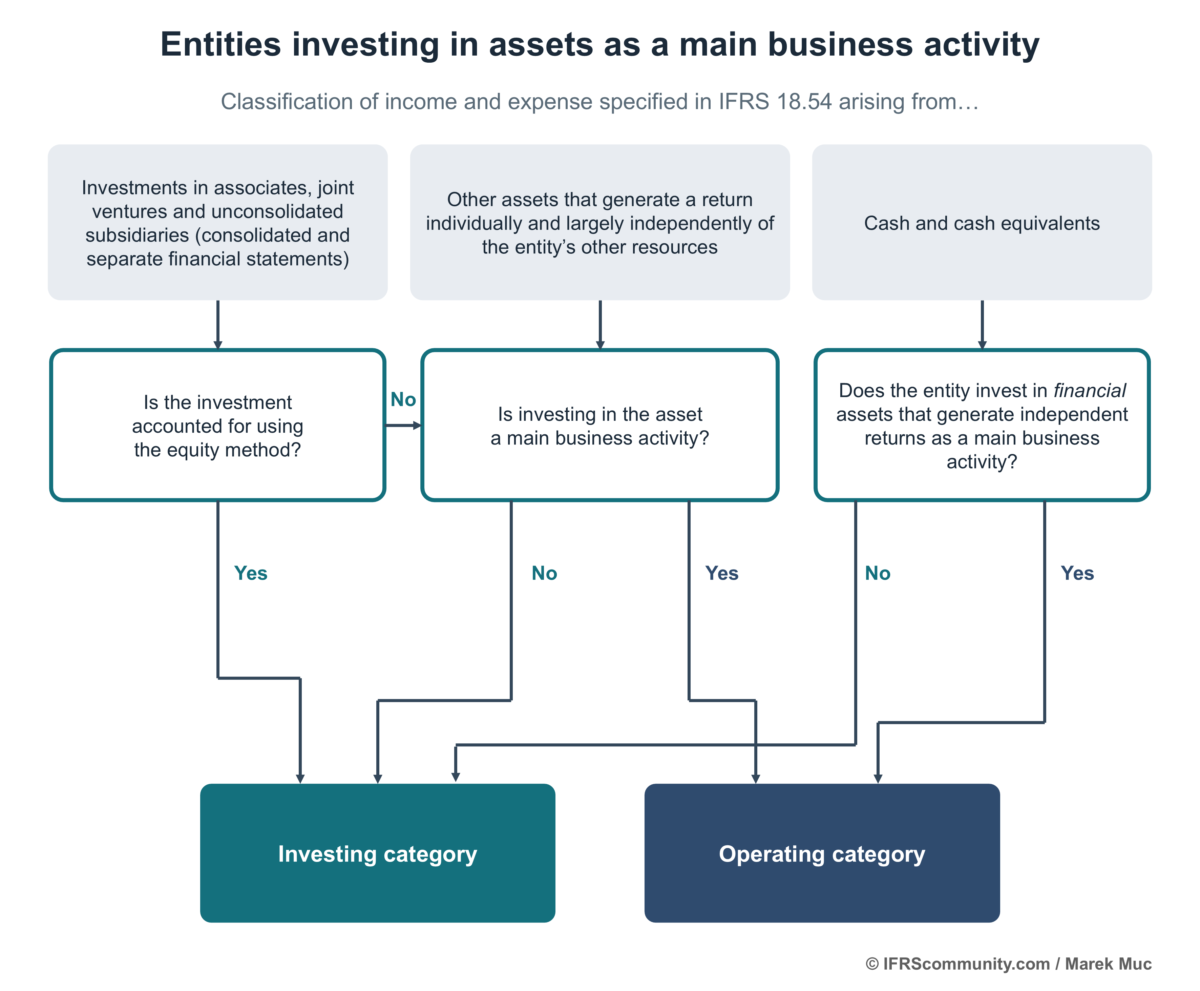
To avoid this mismatch, IFRS 18 requires such entities to classify in the operating category income and expenses arising from assets that generate returns individually and largely independently of the entity’s other resources. The classification requirements for such entities are summarised in the following diagram and discussed below:
Investing in assets generating independent returns
As shown in the diagram above, an entity must assess whether its SMBA involves investing in assets that generate returns individually and largely independently of its other resources. This assessment can be performed for individual assets or for groups of assets with shared characteristics.
For assets that generate returns individually and largely independently of the entity’s other resources and are invested in as part of a main business activity, the related income and expenses specified in IFRS 18.54 are classified in the operating category (IFRS 18.58, B40).
However, an entity that invests in assets as a main business activity might also hold other investments. For example, a real estate investor may also invest in financial assets, but not as a main business activity. In that case, only the income and expenses from the investment property will be classified in the operating category, while those arising from the financial assets will be classified in the investing category.
Investing in associates, joint ventures and unconsolidated subsidiaries
An entity must also assess whether investing, as an SMBA, in associates, joint ventures and unconsolidated subsidiaries that are not accounted for using the equity method is a main business activity. If so, income and expenses arising from those investments, as specified in IFRS 18.54, are classified in the operating category. Investments accounted for using the equity method are not subject to this assessment, with income and expenses from those investments always classified in the investing category (IFRS 18.55).
Investments in unconsolidated subsidiaries include investments in separate financial statements accounted for at cost or using the equity method under IAS 27.10, and those held by an investment entity and measured at FVTPL under IFRS 10.31 and IAS 27.11A (IFRS 18.B44). If a parent prepares separate financial statements under IAS 27 and performs the assessment using groups of assets, those groups should be consistent with the categories used to determine their measurement basis under IAS 27.10 (IFRS 18.B38).
The IFRS Interpretations Committee considered how an ultimate parent of a group assesses whether it has an SMBA when its only activities are holding and managing investments in subsidiaries. In the fact pattern analysed by the Committee, the parent had no substantive activity other than holding and managing investments in subsidiaries and distributing returns from those investments. In these circumstances, concluding that investing in unconsolidated subsidiaries is not a main business activity would result in the parent having no main business activity at all. The Committee therefore concluded that the absence of any other substantive activity is sufficient evidence that investing in unconsolidated subsidiaries is a main business activity. Accordingly, income and expenses from these investments should be classified in the operating category in the parent’s separate P/L.
Income and expenses from cash and cash equivalents
Entities that invest in financial assets as an SMBA must classify in the operating category the income and expenses listed in IFRS 18.54 that arise on cash and cash equivalents (IFRS 18.56(a)). It’s not necessary to assess whether investing in cash and cash equivalents is itself a main business activity (IFRS 18.B39).
The IFRS Interpretations Committee considered whether an entity with an SMBA of investing in financial assets should allocate income earned on cash between that activity and other activities, such as manufacturing products. The Committee concluded that IFRS 18.56(a) requires income and expenses from all cash and cash equivalents to be classified in the operating category if an entity invests in financial assets as an SMBA, regardless of whether it has other main business activities.
Providing financing to customers
For entities that provide financing to customers as a main business activity, the difference between interest revenue from that activity and the interest expense incurred to obtain the related funding is a key measure of operating performance. IFRS 18 therefore introduces specific classification criteria, as summarised below:
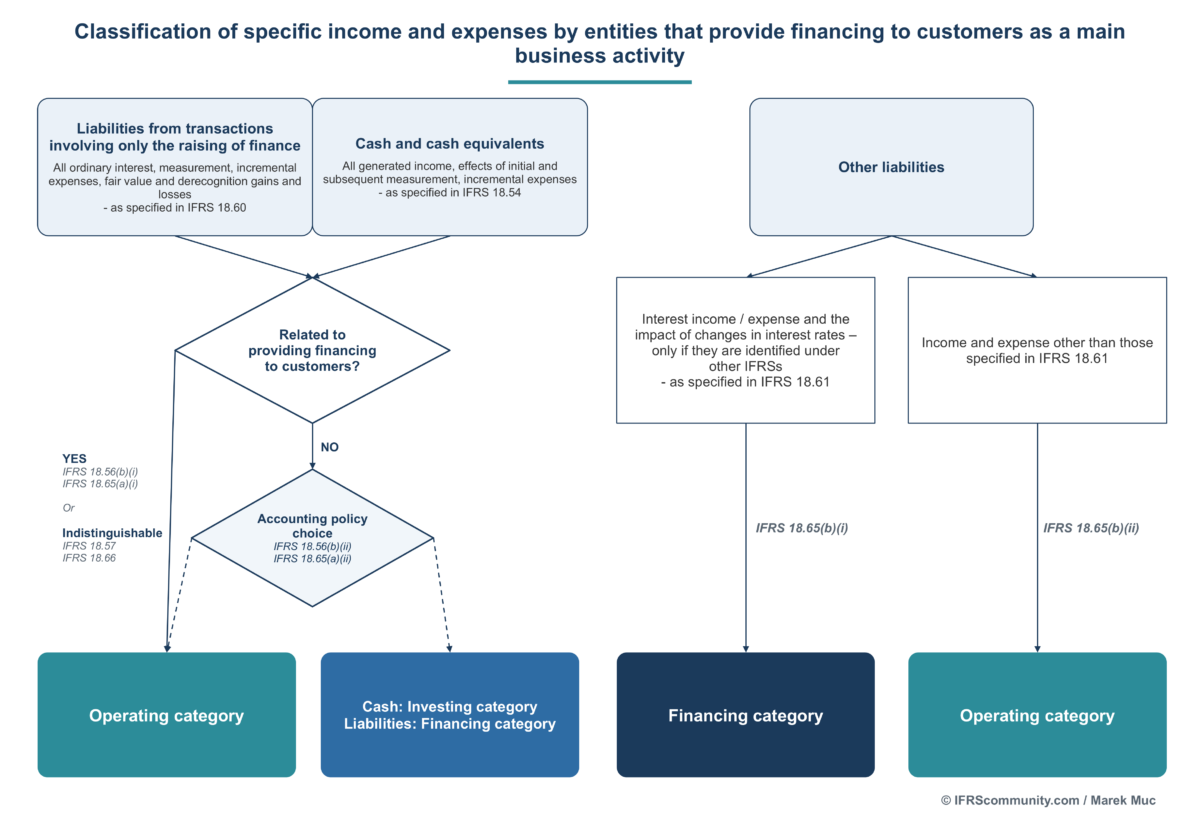
The Basis for Conclusions paragraphs IFRS 18.BC181-BC188 provide background on the IASB’s decision to introduce the accounting policy choice in IFRS 18.65(a)(ii). The IASB acknowledged that some entities may be unable to attribute funding costs to customer financing on a non-arbitrary basis and therefore allowed them to classify all income and expenses from the raising of finance in the operating category. Importantly, this accounting policy choice does not apply to liabilities that don’t arise from transactions involving only the raising of finance, such as lease liabilities under IFRS 16 or employee benefit obligations under IAS 19. For these liabilities, entities that provide financing to customers must apply the general classification criteria. As a result, many banks and other financial institutions had to change their pre-IFRS 18 practices to include all interest expenses within net interest income.
Additionally, the IFRS Interpretations Committee clarified that paragraphs IFRS 18.65-66 apply to the consolidated group as a whole, even when specific subsidiaries do not provide financing to customers as a main business activity.
Example: SMBA of a manufacturer-lessor
The IFRS Interpretations Committee considered a scenario in which a vehicle manufacturer sells its products outright but also leases them out. This manufacturer-lessor:
- manages vehicle sales, finance leases and operating leases together in one line of business;
- classifies its leases as either finance or operating leases under IFRS 16;
- enters into a refinancing arrangement with a bank for each lease contract;
- presents a KPI that is a subtotal for its aggregated lease activity and is similar to gross profit; and
- includes in that KPI income and expenses from finance leases and operating leases, as well as interest expenses on the refinancing arrangements.
The overall question was whether the aggregated lease activity is a specified main business activity of providing financing to customers. The Committee observed that:
- It’s likely that the aggregated lease activity is a main business activity of providing financing to customers. This is evidenced by the entity’s use of one subtotal for its aggregated lease activity as a KPI (IFRS 18.B34).
- The classification of some leases as operating leases doesn’t preclude the aggregated lease activity from being of a type that provides financing to customers.
- The list of entities that might provide financing to customers in IFRS 18.B32 isn’t exhaustive.
Changes in assessment
IFRS 18.B41 clarifies that whether investing in assets or providing financing to customers is a main business activity is assessed based on the facts and circumstances existing at the relevant time. A subsequent change in that assessment does not affect conclusions reached for earlier periods. The entity therefore applies the revised assessment prospectively from the date of the change, without reclassifying amounts presented for prior periods.
IFRS 18.51(c)(ii) specifies the disclosures to be provided when the assessment changes.
More about IFRS 18
See other pages relating to IFRS 18:
Overview of IFRS 18Statement of Profit or Loss
Categories in the Statement of Profit or Loss
Specified Main Business Activities
Presentation and Disclosure of Operating Expenses
Cost of Sales
Other Comprehensive Income
Statement of Financial Position
Classification of Assets and Liabilities as Current and Non-current
Statement of Changes in Equity
Consistency of Presentation, Disclosure and Classification
Aggregation and Disaggregation in Financial Statements
Offsetting in Financial Statements
Transactions with Owners in Their Capacity as Owners
Identification of Management-Defined Performance Measures
Presentation and Disclosure of Management-Defined Performance Measures
Transition from IAS 1