
A statement of profit or loss (P/L) is a primary financial statement and a core part of performance reporting under IFRS. It includes all items of income and expense for a period unless an IFRS Accounting Standard requires or permits otherwise (IFRS 18.46). For example, several standards require or permit certain income and expenses to be presented in other comprehensive income (OCI) rather than in P/L. In addition, the effects of the correction of errors or changes in accounting policies are recognised directly in equity under IAS 8 (IFRS 18.B86).
Let’s dive in.
Presentation alternatives
The statement of profit or loss forms part of the broader statement of financial performance. However, entities can choose to present the statement of financial performance in either of the following ways (IFRS 18.12):
- Two separate statements: a statement of profit or loss and a separate statement presenting comprehensive income, which is the more common approach; or
- A single statement of P/L and OCI, with P/L and OCI presented in two sections. If an entity chooses this less common approach, it must present the P/L section first, followed directly by the OCI section.
IFRS 18 uses the term ‘statement of profit or loss’ to refer both to the P/L section of a single performance statement and to a separate statement of profit or loss (IFRS 18.13).
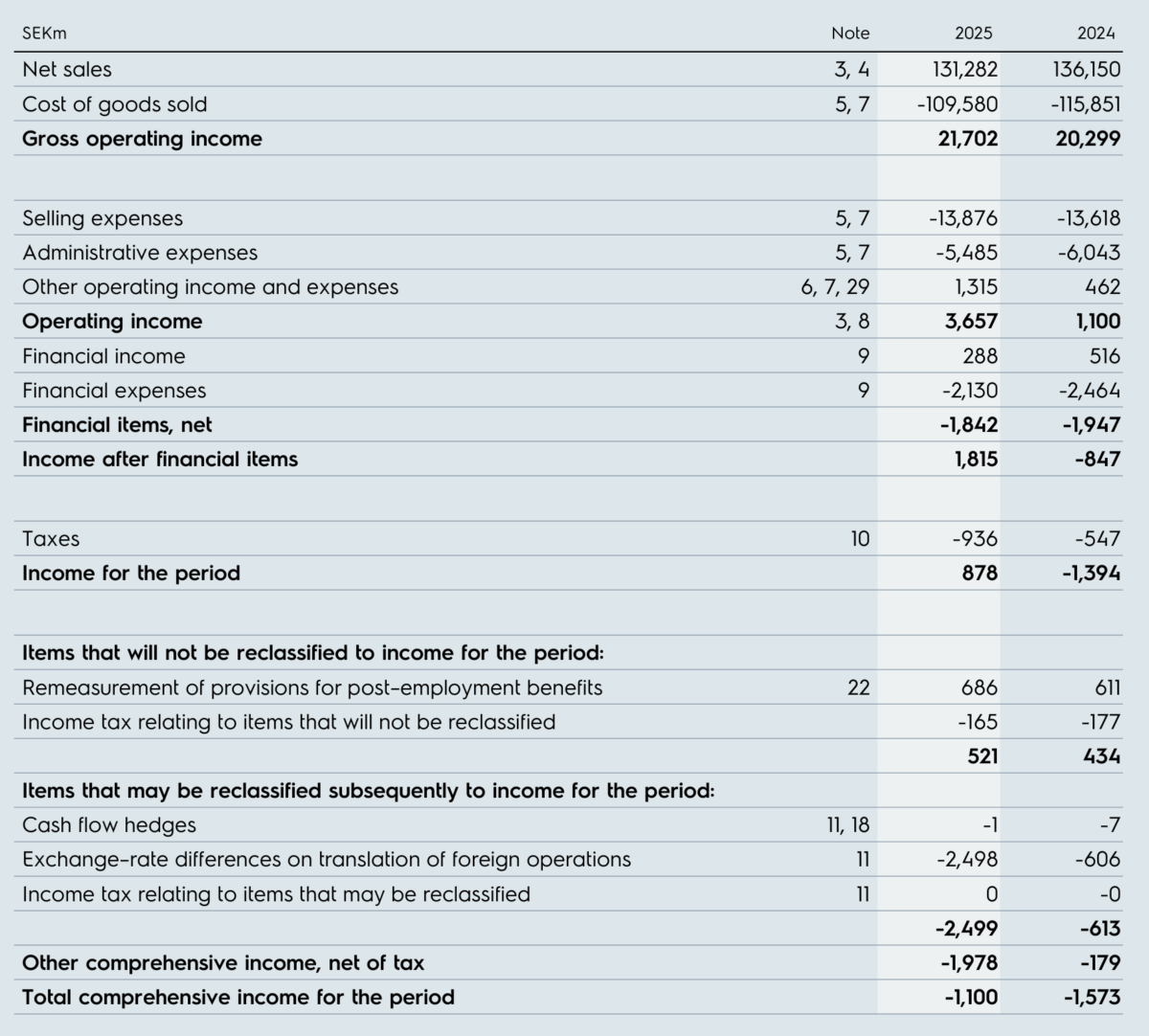
In practice, the two-statement approach is much more common and therefore more familiar. So let’s look at an example of the single-statement approach from Electrolux, although it was still prepared under IAS 1:
Too many IFRS updates? I know the feeling! That's why I created Reporting Period. It's a concise monthly summary of IFRS developments and Big 4 insights for accounting professionals. It's completely free, with zero spam, and you can unsubscribe anytime with one click. Interested? Leave your email below:
Required line items
IFRS 18.75 specifies line items to be presented in the statement of profit or loss, grouped into those required by IFRS 18, IFRS 9 and IFRS 17. These requirements should be considered in the context of the role of the primary financial statements. In essence, a specified line item doesn’t need to be presented if doing so isn’t necessary to provide a useful structured summary in the P/L statement. However, the entity should consider disclosing the omitted item in the notes unless it’s immaterial.
A line item may need to be presented in more than one P/L category. For example, for most entities, impairment losses on trade receivables will be presented in the operating category, while impairment losses on investments in bonds will be presented in the investing category (IFRS 18.B77).
Additional line items
Paragraphs IFRS 18.B78-B79 provide guidance on the judgement required to determine whether additional line items should be presented to provide a useful structured summary of income and expenses in the P/L statement.
Totals and subtotals
The following totals and subtotals must be presented in the statement of profit or loss (IFRS 18.69):
- Operating profit or loss, comprising all income and expenses classified in the operating category;
- Profit or loss before financing and income taxes, comprising operating profit and all income and expenses classified in the investing category; and
- Profit or loss.
Before IFRS 18, many entities presented a ‘profit before income taxes’ subtotal. Its presentation isn’t required under IFRS 18, but entities may voluntarily present it under IFRS 18.24. This subtotal can be useful for benchmarking performance independently of differences between tax jurisdictions.
In addition, a parent preparing consolidated financial statements must present an allocation of profit or loss for the reporting period between NCI and owners of the parent (IFRS 18.76).
Entities providing financing to customers
Entities that provide financing to customers as a main business activity have an accounting policy choice regarding the classification of income and expenses related to liabilities arising from transactions that involve only the raising of finance but don’t relate to the provision of financing to customers. Entities that elect to classify such income and expenses in the operating category cannot present the subtotal ‘profit or loss before financing and income taxes’. This is because the IASB concluded that presenting such a subtotal would be misleading, as most financing expenses would be included within it.
Instead, such entities apply IFRS 18.24 to determine whether to present an additional subtotal after operating profit and before items classified in the financing category. However, if an entity presents an additional subtotal comprising operating profit or loss and all income and expenses classified in the investing category, it must not label that subtotal in a way that implies financing amounts are excluded. For example, ‘profit before financing’ would be misleading (IFRS 18.73-74).
More about IFRS 18
See other pages relating to IFRS 18:
Overview of IFRS 18Statement of Profit or Loss
Categories in the Statement of Profit or Loss
Specified Main Business Activities
Presentation and Disclosure of Operating Expenses
Cost of Sales
Other Comprehensive Income
Statement of Financial Position
Classification of Assets and Liabilities as Current and Non-current
Statement of Changes in Equity
Consistency of Presentation, Disclosure and Classification
Aggregation and Disaggregation in Financial Statements
Offsetting in Financial Statements
Transactions with Owners in Their Capacity as Owners
Identification of Management-Defined Performance Measures
Presentation and Disclosure of Management-Defined Performance Measures
Transition from IAS 1